
Running an internal pickleball tournament for 16–32 pairs
Formats sized by pairs and courts, how to shorten matches when courts are scarce, splitting by level, and the right tiebreakers for a set-scored sport.
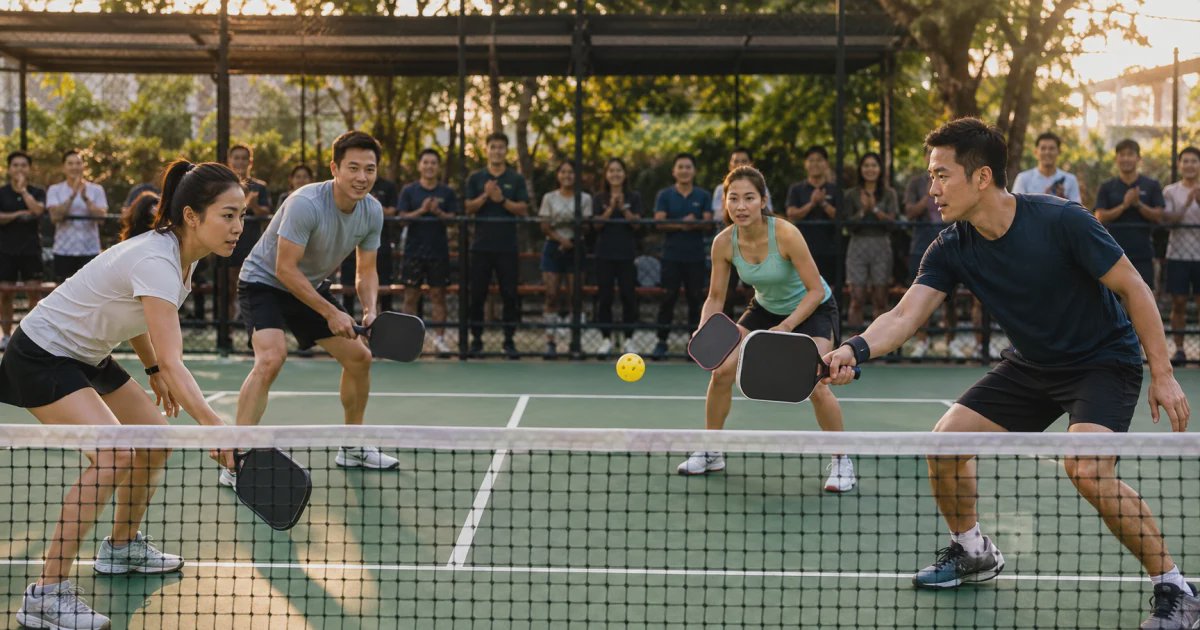
Pickleball is the easiest office sport to run a tournament in: learnable in one session, mixed doubles on the same court, 15–25 minutes a match. But short matches are exactly why the match count balloons — 16 pairs is already 24 group matches, and on two courts that is four straight hours.
This is a concrete plan for an internal event of 16 to 32 pairs, sized by how many courts you can book.
Decide the format before the entry count
Three formats are workable. Pick by what you want out of the day:
Groups then knockout — the default. Every pair plays at least three matches, there is a table to follow, and there is a final to hand a trophy at. Use this for the official company event.
Full round robin — only viable under 8 pairs. Eight pairs is 28 matches, a full day of court time on its own.
Rotating partners (new partner each game) — everyone enters as an individual, is paired with someone different each game, and scores accumulate individually. This builds the most goodwill because everyone plays with everyone, but there is no champion pair for the trophy photo. Use it for a social session, not for a tournament with prizes.
Setups by entry count
16 pairs, 2 courts, one day
- 4 groups of 4, round robin within the group: 24 matches
- Top two per group to the quarterfinals: 8 matches (quarters, semis, final, third place)
- 32 matches total. At 20 minutes average on two parallel courts: about 5 hours 20 minutes of play; reserve roughly 6 hours 30 minutes after adding the 20% buffer.
- Every pair plays at least three matches.
24 pairs, 3 courts, one day
- 6 groups of 4: 36 matches
- Six group winners plus the two best runners-up to the quarterfinals: 8 matches
- 44 matches on three courts: about 4 hours 55 minutes of play; reserve roughly 6 hours after adding the buffer.
- Publish the comparison criteria for the best runners-up up front — set difference, then points ratio.
32 pairs, 4 courts, a tight single day or two sessions
- 8 groups of 4: 48 matches
- Top two per group to the round of 16: 16 matches
- 64 matches total. On four courts that is about 5 hours 20 minutes of play; reserve roughly 6 hours 30 minutes after adding the buffer.
- Safer: group stage Saturday morning, knockout Sunday afternoon.
The formula to size your own: matches × average length ÷ courts, plus 20% for changeovers, disputes and matches that go to a tiebreak.
Shortening matches when courts are scarce
Under USA Pickleball's current playing guide, the common format is to 11, win by 2, on side-out scoring — only the serving pair can score. A recreational match typically runs 15–25 minutes, with a grinding one going past 30.
When the schedule is tight, use one of these:
- One group-stage game to 11, win by 2, capped at 13. The cap is the important half: without it a close game can run long and drag the whole schedule with it.
- Rally scoring to 15. Every rally scores, so match length is predictable. It differs from the traditional laws, so it has to be written into the regulations.
For the knockout, you can return to side-out scoring, win by two and remove the cap if court time allows. Whichever option you choose, put the same rule in both the regulations and the published schedule.
Split by level, or the tournament dies in the group stage
Skill spread inside a company is wide: someone two years in against someone who first held a paddle last week. Put them in the same group and one side is bored while the other is embarrassed.
Two ways to handle it:
Separate divisions. Division A for regular players, Division B for beginners. Two competitions, two sets of prizes. This is the fairest option and it raises the number of people willing to enter at all.
Balanced pairings. Require every pair to combine one stronger and one weaker player. Better for cohesion, but it needs a committee lead with enough standing to assign tiers without offending anyone.
If anyone in the company uses a rating system like DUPR, use those numbers. If not, a three-tier self-assessment survey — new, occasional, regular — is accurate enough for an internal event.
Tiebreakers: pickleball is not football
This is where committees copy the wrong regulation. Pickleball has no goal difference. The correct order:
- Matches won
- Set difference (sets won minus sets lost)
- Points ratio (total points won divided by total conceded)
- A deterministic final criterion — original seeding, or a draw
The detail, including the three-pairs-level trap: Teams level on points.
Match-day checklist
- A large printed schedule at the venue, with a QR code that opens the tournament page on a phone
- One court coordinator, kept separate from the refereeing role
- Spare balls — outdoor pickleballs crack constantly
- Water, ice and shaded seating for pairs waiting to play
- Someone photographing at least the final
Running it
Matchup builds a pickleball tournament in the format you choose, understands set-based scoring, and applies the tiebreaker set that belongs to set-scored sports rather than the football one. Each court gets its own scoring link for whoever is running it, the table and the bracket update immediately, and the whole event sits on one public link with a QR code for the venue.
Up to 8 matches is free. A 16-pair event lands on the 149,000₫ tier; 32 pairs uses the 299,000₫ tier, which includes a VAT invoice.
Create a pickleball tournament · Pricing
Read next: Internal company sports tournament plan · Group draw tool